
After strong start, Maui’s tourism recovery flattens as 2025 comes to a close
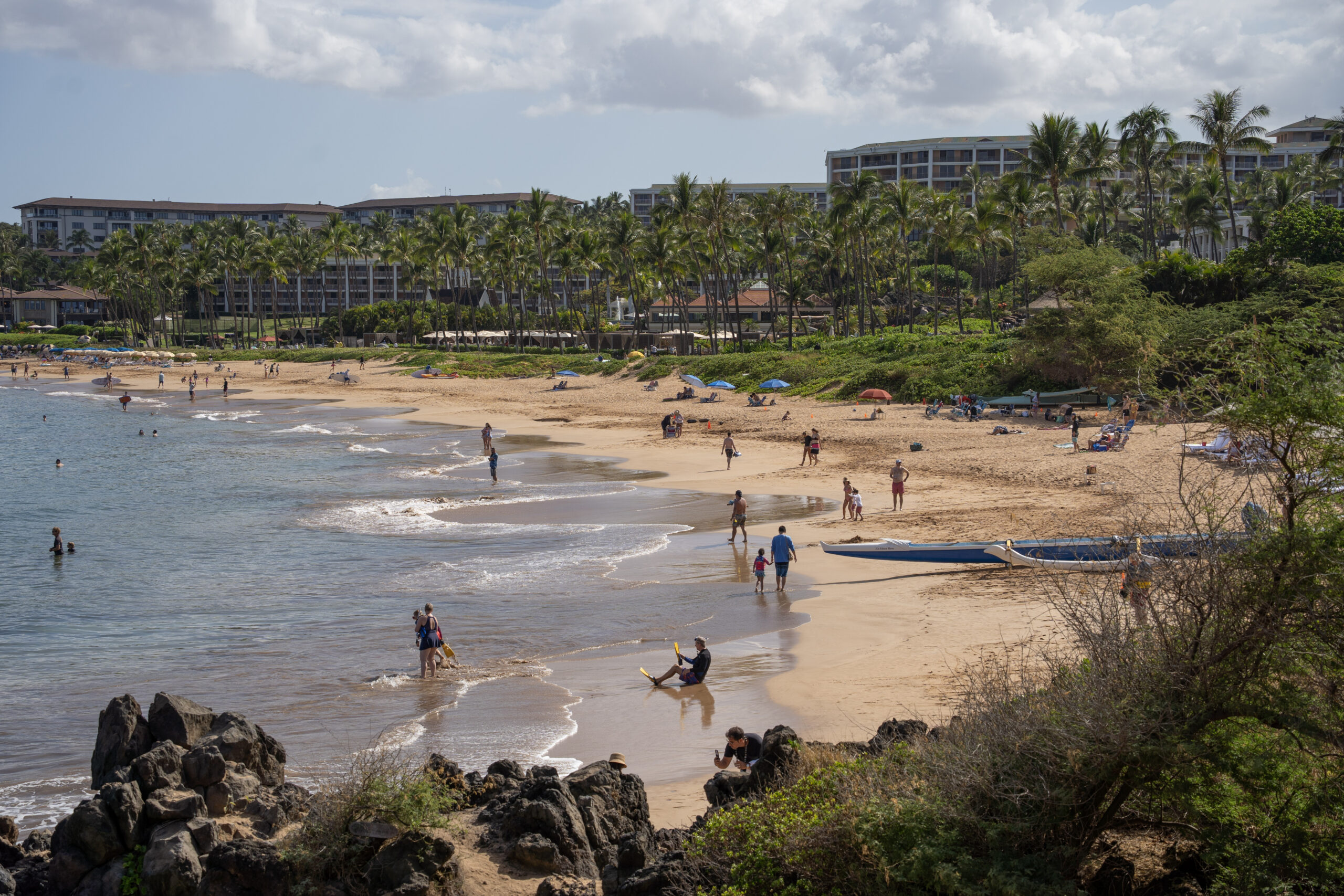
Maui’s recovering tourism industry got off to a strong start at the beginning of 2025, but growth has slowed with declining international arrivals and a 43-day government shutdown that weakened visitor demand across the state, local economists said Thursday.
“Maui was down and it was recovering, but it’s now also facing the same headwinds that all four counties are facing, and that’s going to slow the recovery,” said Steven Bond-Smith, economist and assistant professor with the University of Hawai‘i Economic Research Organization.

On Friday, the organization released its final economic forecast of the year, which predicts that Hawai‘i’s economy will continue to slide into a mild recession with tourism down and job losses on the horizon in 2026.
Maui’s ongoing recovery from the August 2023 wildfires in Lahaina and Kula has put the island in a unique position. Tourism, the main economic driver, still hasn’t recovered fully, but because people are still returning in the wake of the fire, Maui is seeing less of a decline than other islands, explained Carl Bonham, executive director of the organization.
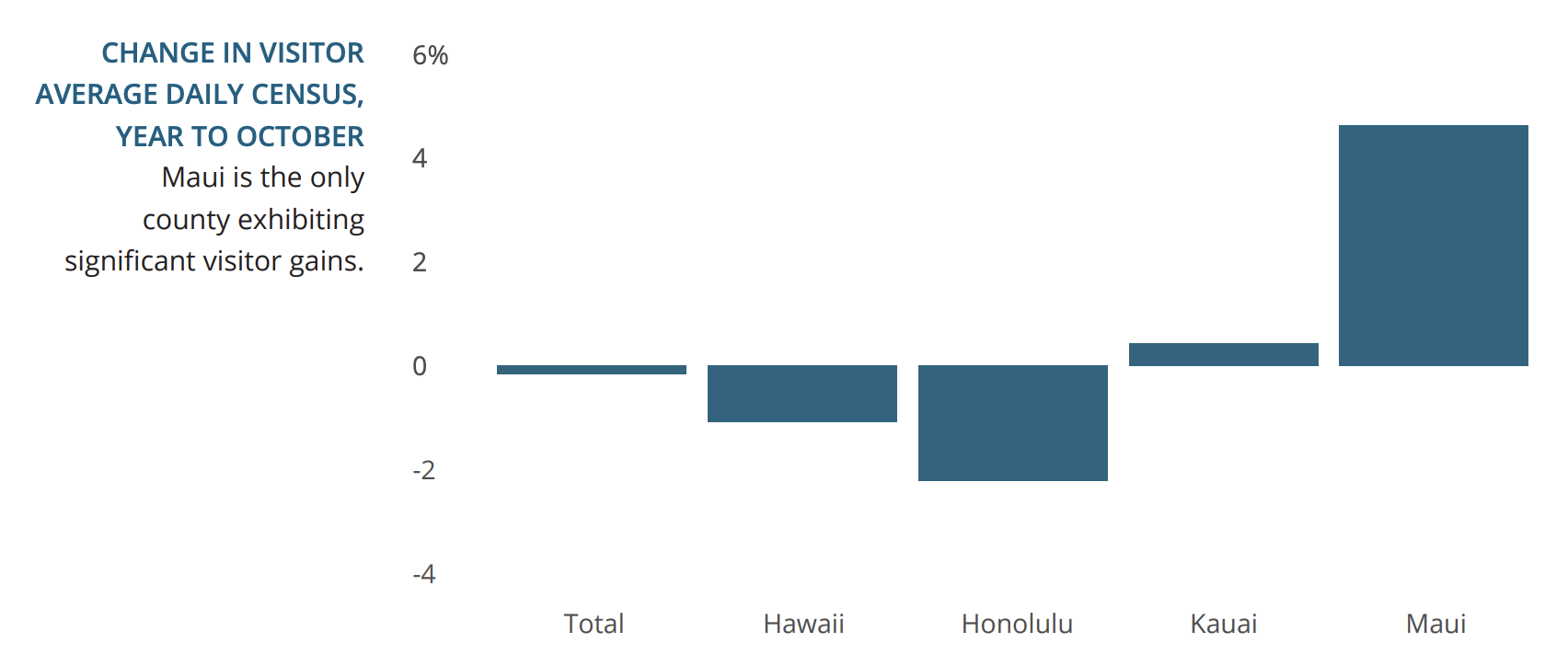
“Maui basically went from a good start to the year to flat,” Bonham said. “And the other counties, particularly O‘ahu, went from a good start to the year to a really sharp slowdown, really in the early summer and into the summer. Big Island, kind of similar. So in some ways, Maui is outperforming, certainly O‘ahu and the Big Island, probably because it’s still in that process of recovery.”
From January to October of this year, Maui logged 2.07 million visitor arrivals, a 7.6% increase from the 1.93 million visitors who came during the same period in 2024, according to data from the state Department of Business, Economic Development and Tourism. No other island has seen more than a 2.5% increase over the previous year, and Lāna‘i, Moloka‘i and O‘ahu have all experienced declines.
Part of that may be driven by incentives like discounted prices at Maui County hotels, where rates in October were about 8% lower than a year earlier. They helped boost occupancy rates by nearly 20 percentage points, according to UHERO’s report. Other islands, in comparison, saw little changes in their hotel occupancy rates.
As tourism tapers off on other islands, Maui County’s share of statewide visitors has risen from only 14% right after the fires to 25% in October, just 3 percentage points less than what it was before the fire.
“As the weakness from the U.S. economy and the international markets plays out, Maui is not hit quite as hard because there’s this offsetting of people beginning to return to Maui,” Bonham said.
The report said that if Hawai‘i ends the year “in the black, it will be thanks to healthy Spring numbers and a return of Maui visitors.”
Signs of economic recovery continue to emerge, including in Lahaina’s once-bustling business district where the partial reopening of the harbor for limited commercial activities is “obviously a positive,” Bonham said. At the same time, he pointed out, the island also recently lost the PGA Tour’s Sentry tournament, which had an estimated $50 million impact.
Maui’s tourism industry and overall economy is still a long way from getting back to normal, Bonham said. A key metric economists look to is the average daily census, which is the number of visitors on the island on any given day, because it reflects both visitor arrivals and their length of stay. On Maui, the average census was 52,389 from January to October, up from 49,800 during the same period in 2024 but still below the count of 64,634 during the same period in 2022.
The market for U.S. Mainland visitors has softened and Canadian arrivals are also “down sharply,” which impacts Maui because these are the two primary markets that the island’s visitor industry relies upon.
The government shutdown, which started on Oct. 1 and lasted a record 43 days, also curbed travel as the federal government mandated flight cuts at 40 major airports, including Daniel K. Inouye International Airport in Honolulu.
The effects of the shutdown rippled across the local economy as roughly 34,000 federal employees across the state went without pay and recipients of federal initiatives like the Supplemental Nutrition Assistance Program missed out on their benefits, reducing household spending overall. In Maui County, more than 18,000 people rely on SNAP.
As federal workers receive back pay and catch up on their bills, some of those effects will be reversed, but “it’s still a negative impact,” especially in what is already a weakened economy, Bonham said. Some lost spending just won’t be made up: “You’re not going to go to your doctor three times in December because you missed your monthly appointment in October and November,” he said.
Ongoing federal layoffs are also likely to impact a market in which job creation has “stalled out,” the report said. Still, unemployment remains low in Hawai‘i, with rates projected at 2.8% for 2025, slightly under the 3% seen in 2024. Maui is the only county expected to see unemployment drop from 4.3% in 2024 to 3.2% in 2025. The other three counties are anticipated to see either no change or a slight increase in unemployment.
Starting in 2026, the minimum wage statewide will increase from $14 to $16 per hour, part of a decadelong plan that will cap out at $18 an hour in 2028. That’s expected to boost the incomes of lower-wage workers, but it could create cost challenges for employers, the report said.
But, Bonham said, “the vast majority of what’s driving our forecast of a mild recession is coming out of Washington,” not what’s happening in the local economy. The increase in minimum wage is coming at a time when the economy is already weak and businesses are facing rising costs as tariffs take a toll. Most of the job losses over the last several months are due to federal civilian employees.
“The economy is much weaker, the hiring is already weaker … and so we think there’s a possibility that this is going to contribute to entry-level workers having a hard time finding a job,” Bonham said. “And anybody who might lose a job because of the slowdown in tourism or other parts of the economy is going to have a harder time getting back to work.”
One bright spot, however, has been the construction industry, with federal projects on O‘ahu likely to keep construction employment near record levels through the end of the decade.

On Maui, 300 homes in the burn zones are under construction, and last week the island reached a major benchmark as the 100th structure was completed, the county announced.
Last year, the value of Maui County’s residential building permits totaled $434 million, according to UHERO data. Bonham said 2025 looks like it’s on pace to not only surpass that value but also the 2021 peak of $450 million. He said “the rebuilding on Maui is definitely contributing to the overall activity in the state,” but that federal government projects, primarily at Pearl Harbor on O‘ahu, are the biggest factor in construction spending and activity.
Overall, growth in the construction industry “will help cushion the downturn but cannot fully offset weakness elsewhere in the economy,” the report said.
“Job and income losses will be real but limited in scale, with the greatest burdens falling on lower-income households and sectors tied to tourism and federal spending,” the report added. “Significant uncertainties remain — from trade policy and deportations to the ability of the Federal Reserve to steer the national economy — but prospects look somewhat better than they did earlier this year.”
